June 2026
Technical Report: Re-validation of the PerfLab DCE-MRI Pipeline
Comparative analysis of regularization, AIF modeling, and real-world repeatability against OSIPI benchmarks.
The updated version of the PerfLab software demonstrated improved performance compared with the original implementation submitted to the OSIPI-DCE challenge. The challenge evaluates DCE-MRI perfusion analysis using two complementary validation tasks: accuracy, assessed on two realistically simulated datasets with known ground-truth perfusion parameters, and repeatability, assessed on repeated clinical examinations of eight patients. The comparison of the original and updated implementations using the official OSIPI-DCE evaluation metrics is summarized in Table 1.
| Evaluation metric | Original PerfLab | Updated PerfLab | Improvement |
|---|---|---|---|
| Accuracy score (Ktrans estimation, simulated OSIPI datasets) | 0.78 | 0.86 | +10.3% |
| Repeatability score (clinical OSIPI dataset, 8 patients) | 0.80 | 0.90 | +12.5% |
Table 1: Comparison of the original and updated PerfLab implementations using the OSIPI-DCE evaluation metrics.
These improvements were achieved through several methodological enhancements, particularly in arterial input function (AIF) estimation and pharmacokinetic parameter calculation. A new automatic AIF estimation method based on blind deconvolution with automatic arterial voxel detection reduced user dependency while preserving subject-specific contrast dynamics. In addition, AIF scaling was improved using the dominant reference tissue method, and pharmacokinetic parameter estimation was enhanced by introducing a spatially regularized optimization algorithm.
The regularized optimization produced more stable Ktrans parameter maps while preserving anatomical detail, resulting in improved reproducibility on the clinical repeatability dataset. The influence of the regularization strength on the spatial characteristics of the resulting parameter maps is illustrated in Figure 1, where increasing regularization levels demonstrate the trade-off between noise suppression and preservation of fine anatomical details. Together with the improved AIF estimation and scaling procedures, these methodological enhancements increased the agreement between the estimated and reference perfusion parameters on the simulated OSIPI datasets while also improving the repeatability of quantitative analysis on clinical data.
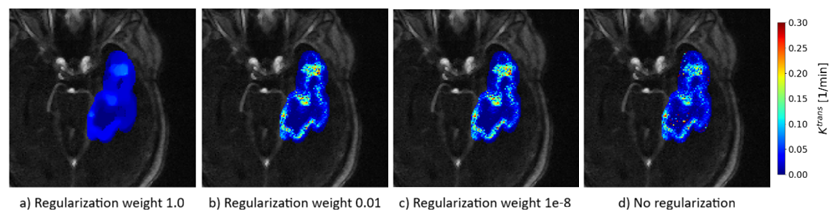
Overall, the updated PerfLab pipeline provides a more accurate, robust, and fully automated framework for quantitative DCE-MRI perfusion analysis than the original software version. The improved performance achieved in both OSIPI-DCE evaluation tasks confirms the effectiveness of the implemented methodological enhancements and supports the use of the updated software for reliable quantitative perfusion assessment.